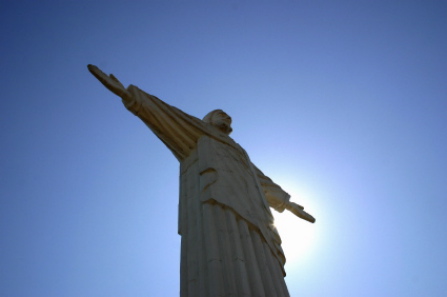
Jesus Christ over Amparo City, Sao Paulo, Brazil – © 2006 Mauricio Cabral – Agency: iStockPhoto.com
Now found in 57 countries, the Heralds of the Gospel is an outgrowth of the Brazilian conservative Catholic movement Tradition, Family and Property(TFP) and its controversial founder Plinio Correa de Oliveira, a staunch critic of liberalism in the church and Brazilian society and an upholder of monarchism.
At the April conference of the Association for the Study of Economics, Religion and Culture in Washington, DC, which was attended by Religioscope, Introvigne presented a paper noting that the transition from TFP to the Heralds of Gospel has been complex and not without controversy.
TFP was founded in 1960 but was soon pushed to the margins of the Brazilian church as it liberalized under the influence of Vatican II and more specifically liberation theology, which sought to include Marxist analysis in its agenda. These liberal currents predominated among the Brazilian bishops and church structure until the papacy of John Paul II in 1978.
The pope’s condemnation of liberation theology as well as the growth of Pentecostalism led to a more conservative period in the Catholic church in Brazil, as church leaders sought to prevent more Catholics from leaving for more conservative Protestant churches. During this time, TFP functioned somewhere between a religious order and a religious and social movement. Although members were celibate and lived in communal houses, Correa de Oliveira refused to make the TFP a religious order, since it would put the organization under the jurisdiction of bishops who opposed it.
But when Correa de Oliveira died in 1995, the TFP split between those members who favored the model of religious congregation and those favoring the model of a lay movement. The opposing sides went to court in 1997 to claim the TFP trademark– a case that has yet to be settled. The group that won the right to the TFP trademark in Brazil (though not in other countries) eventually formed the Heralds of the Gospel in 1999.
By 2001 the Heralds of the Gospel was recognized by the Vatican as an association of pontifical right–a surprisingly quick time, according to Introvigne. The group has grown very rapidly with several thousand celibate members worldwide, mainly young adults. The group stresses the “new evangelization” and its music ministry. The Heralds played a prominent role during the pope’s 2007 visit to Brazil and in the celebrations for the 100th anniversary of the Archdiocese of Sao Paolo in 2008, according to Introvigne.
Several of its leaders have already been ordained and, unlike TFP, the organization has both male and female members and has developed friendly relations with some Brazilian bishops. At the same time, the group downplays its link with Correa de Oliveira and his political ideas, though its leaders are the same people who were associated with him in TFP; the older members still hold a devotion to his memory.
Introvigne said that the emergence of the Heralds of the Gospel can be seen as part of a long range strategy in Brazil and other countries to cater to the needs of conservative and strict Catholics. Pope Benedict XVI has engaged in a similar strategy on a higher level, as he has sought to negotiate with traditionalist Catholics, granting them greater freedom in holding Latin Masses and lifting the excommunications on several of their bishops.
Richard Cimino
Richard Cimino is the founder and editor of Religion Watch, a newsletter monitoring trends in contemporary religion. Since January 2008, Religion Watch is published by Religioscope Institute. Website: www.religionwatch.com.
