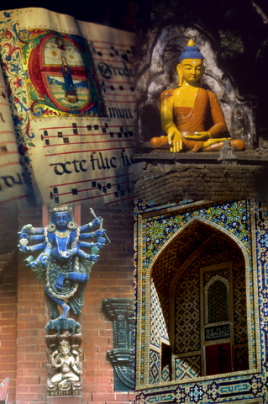
Religious montage: four religions | © Steve Estvanik, Cascoly | Dreamstime.com
The Episcopal Church has seen controversies over both sexuality, such as gay rights, and interfaith theology in recent years, leading to a growing number of conservative churches leaving the denomination.
The Rev. Kevin Forrester was elected bishop in the Diocese of Northern Michigan in late February, receiving 88 percent of the delegate votes. The church’s bishops still have to approve Forrester but that process rarely results in the votes being overturned. Yet the election has led to a new wave of protests that the denomination is compromising its Christian identity as well as praise from Eastern religious groups.
Forrester has claimed that he is following the path of both Christianity and Zen Buddhism. In a letter to questioners of the election on he wrote: “I have been blessed to practice Zen meditation for almost a decade. About five years ago a Buddhist community welcomed me as an Episcopal priest in my commitment to a meditation practice-a process known by some Buddhists as `lay ordination.'”
He added that “Literally thousands of Christians have been drawn to Zen Buddhism in particular because, distinct from western religions, it embodies a pragmatic philosophy and a focus on human suffering rather than a unique theology of God.”
Forrester, is not the first Episcopal clergyman to practice dual faiths. In 2004, a Pennsylvania priest was revealed to be a druid. In 2007, a priest in Seattle declared that she was both an Episcopalian and a Muslim. Both were eventually “inhibited” from priestly duties. A similar controversy simmering in the church is the trend of allowing unbaptized people of other faiths to partake of the Eucharist.
James Tonkowich, president of the Institute on Religion and Democracy, a conservative think tank focusing on reform of the mainline denominations, commented on the Forrester election, saying that “These interfaith innovations go far beyond witnessing and respecting other faith traditions. They seek to blend Christianity with other belief systems…Buddhism is not merely a series of practices, saying so devalues it. Buddhism is an entire worldview.”
Buddhist groups have greeted Forrester’s election with praise. The website, New Buddhist.com, said the election will encourage greater “hope and universalism” between the religions.
But the fact that the controversy surrounds a bishop– in contrast to the past cases of dual religious identity in the priesthood– may make the issue more divisive in the denomination. The last controversy surrounding a bishop’s election concerned Gene Robinson, who became the first self-proclaimed gay bishop in the church, leading to the continuing schism in the church.
Richard Cimino
Richard Cimino is the founder and editor of Religion Watch, a newsletter monitoring trends in contemporary religion. Since January 2008, Religion Watch is published by Religioscope Institute. Website: www.religionwatch.com.
