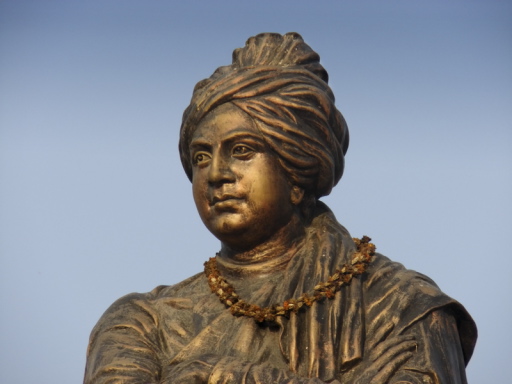
A statue of Swami Vivekananda in Haridwar, India. – © 2008 Bnilesh | Dreamstime.com
The first Vedanta center was founded by Swami Vivekananda in 1894 in New York. The Vedanta societies 14 centers have traditionally catered to white Americans interested in Indian spirituality but not necessarily the rituals and traditions usually associated with the religion. Some of the societies featured distinctly Protestant settings, including sermons and pews.
This pattern started changing in the 1960s when many Indian Hindus immigrated to the U.S. They brought with them Hindu rituals and culture—a process many American Vedantists have called “Indianization.”
As the Indian Hindu influence in Vedanta societies has grown, Indianization has become a point of contention in the national movement. Hinduism Today magazine (July/August/September 2008) cites a recent issue of an unofficial Vedanta publication which suggests a good deal of disagreement, even among leaders, about the nature of the Vedanta society in a multicultural America.
One white Vedanta member cited in the issue welcomes the influx of Indians into the movement, adding that it will help Americans learn more about the origins and basics of Hinduism. Another anonymous member argues that many American members cannot relate to the “pujas to many Gods and Godesses,” and envisions that the only remaining whites will be a “few American women in saris and dots on their foreheads.”
William Conrad, a biophysicist and president of Vedanta West Communications, said that he has observed that in the past about 50 percent of the Western newcomers to Vendata societies had heard about the group from other Westerners who had been to one of the centers. In recent years, however, most of the people who have come to the centers have learned about Vedanta on the Internet. Conrad adds that “As the number of Westerners decreases, the number who can be informed by word- of- mouth in this way also decreases in a self-reinforcing loop.”
Conrad said that the individualistic and critical attitude fostered among Vedanta members may be in jeopardy as Indians, who generally do not question their swamis, predominate at the societies. In contrast, Hindu critics charge that Vedanta is not authentic Hinduism but rather a syncretistic faith that has a Western mindset.
Vasudha Narayanan, a Hindu scholar at the University of Florida (Gainesville) told Religioscope in an interview that both sides of the conflict tend to view Hinduism and even Vedanta in a monolithic way that downplays its diversity. While Swami Vivekananda emphasized the philosophical and meditational dimensions of Hinduism, he did not discard all rituals. In various Vedanta societies in the U.S. rituals are practiced. There are also various forms of Vedantic thought among Hindus in India, she added.
South Indians who have moved into Vedanta societies may have a very specific understanding of the religion. The point of contention in the current situation in the Vedanta societies is “sorting out…the universalistic and the ethnic dimensions of Hinduism,” Narayanan said.
Richard Cimino
Richard Cimino is the founder and editor of Religion Watch, a newsletter monitoring trends in contemporary religion. Since January 2008, Religion Watch is published by Religioscope Institute. Website: www.religionwatch.com.
